ARCHIVES


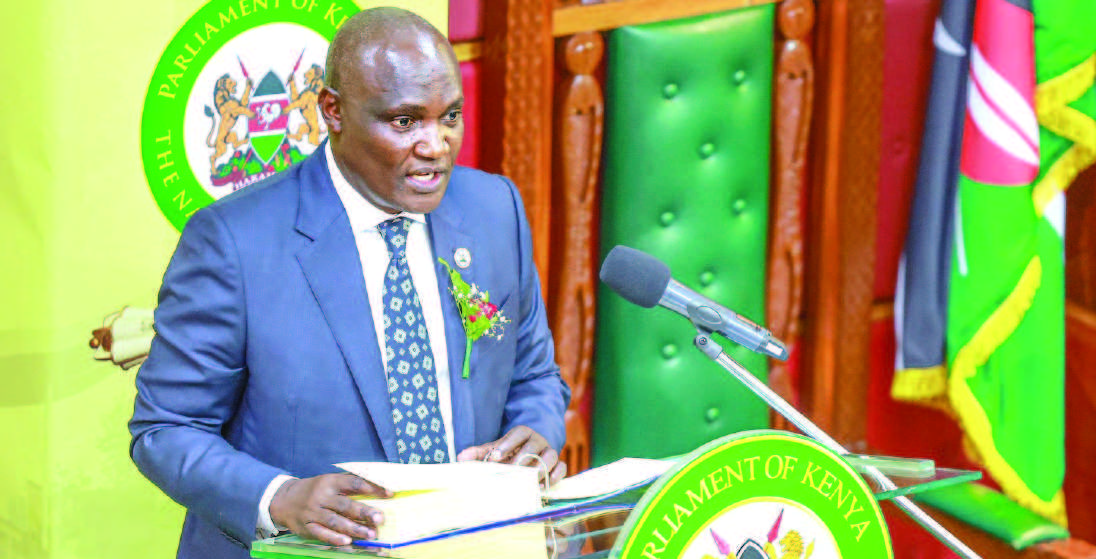
National Treasury Cabinet Secretary John Mbadi will read the budget today, setting the stage for one of the most delicate iscal balancing acts in recent years.
It comes at a time Kenya is grappling with a heavy debt repayment burden, growing public demand for relief from the high cost of living, and increasing pressure to fund key government programmes. Mbadi will be expected to strike a careful balancing act between iscal discipline and economic recovery.
Being the second budget for Mbadi since he took over as the National Treasury Cabinet Secretary, he is expected to demonstrate how is going to inance the budget and ensure sectors such as education, health, agriculture and infrastructure are well funded.
The presentation of the budget comes at a time when millions of Kenyans are struggling with the rising cost of living, unemployment and shrinking household incomes.
In addition, this budget is also being prepared at a time when Kenya’s public debt has been on the rise and has continued to consume a signiicant portion of government revenues.
The 2026/27 budget is expected to be inanced predominantly through domestic borrowing, which is projected at Ksh997.8 billion, accounting for approximately 90 percent of the total inancing requirement.
External inancing is projected at Ksh116.2 billion, representing about 10 percent of the deicit inancing. This inancing structure indicates a signiicant shift towards reliance on domestic sources compared to the proportions approved in the Budget Policy Statement, where domestic borrowing accounted for 80 percent of the inancing mix.
The presentation of the budget comes even as MPs underscored the need to ensure that the revenue targets are actualised, given the historical revenue underperformance and prevailing global geopolitical and economic dynamics.
Budget risk
The Budget and Appropriations Committee (BAC) chaired by Alego Usonga MP Samuel Atandi warned that any shortfall in revenue collection could result in a larger-than-projected iscal deicit by the close of FY 2026/27, thereby increasing borrowing.
In its report tabled in the National Assembly the committee noted that risks to inlation remain elevated in view of the global geopolitical dynamics and disruptions in supply chains.
This, it says, poses signiicant risks to the implementation of the Budget by increasing the cost of government operations, infrastructure projects, and public service delivery.
“Elevated inlation may also weaken household purchasing power, constrain economic activity, and negatively afect revenue performance,” the report reads. The presentation of the budget also comes at a time when the National Treasury has allocated Ksh2.31 trillion for payment of public debt comprising Ksh1.06 trillion in redemptions, or principal repayments, and KSh1.25 trillion in interest payments.
In its report the Public Debt and Privatisation Committee has raised concerns that interest payments account for the larger share at 54 percent, relecting the continued cost of carrying public debt.The committee has also raised concern that Domestic debt service is projected at Ksh1.64 trillion representing an increase of Ksh207.49 billion from Ksh1.43 trillion in FY 2025/26.
The increase, the report says, is largely attributable to rising interest payments and redemption obligations associated with Government securities, particularly Treasury bonds.
Reads the report: “The public debt stock, which amounted to Ksh 12.84 trillion as at February 2026, is projected to reach Ksh14.12 trillion by June 2027, equivalent to a Net Present Value of public debt to GDP ratio of 65 percent. This remains above the statutory debt anchor of 55 percent, with a 5 percent margin, leaving only one year to meet the October 2028 target. If the target is not met, it may weaken the credibility of the iscal rules framework and the legislative measures intended to support prudent iscal management.”
In the budget highlights to be presented, the Education sector is the biggest beneiciary receiving Ksh781.4 billion to support basic, tertiary and university education. The allocation includes Ksh 4.9 billion for the employment of 20,000 intern teachers on permanent and pensionable terms . The health sector has been allocated Ksh175.5 billion to strengthen Universal Health Coverage (UHC), improve primary healthcare and expand specialised medical services.
Health allocations
Among the key allocations are Ksh19.1 billion for the Primary Healthcare Fund, Ksh4 billion for the Emergency, Chronic and Critical Illness Fund, and Ksh 18.5 billion for programmes combating HIV/AIDS, malaria and tuberculosis.
Housing and urban development will receive Ksh 138.2 billion, including Ksh 50 billion for the Afordable Housing Programme aimed at increasing home ownership opportunities and creating jobs for youth speciically in the construction sector.
Cash transfers to older persons will get Ksh8.9 billion for orphans and vulnerable children, and Ksh12.5 billion for the National Youth Service to support youth empowerment and skills development. In the energy sector, Ksh16.3 billion was allocated for rural electriication and Ksh7.5 billion for expansion of the national grid.
Defense allocation has been increased by KSh10.6 billion from KSh241.5 billion to KSh252.1 billion. The NYOTA programme has been allocated Ksh2.5 billion.
REVENUE TARGETS
MPs underscored the need to ensure that the revenue targets are actualised, given the historical revenue underperformance and prevailing global geopolitical and economic dynamics.
Shortcomings in revenue collections could cause fiscal deficits