
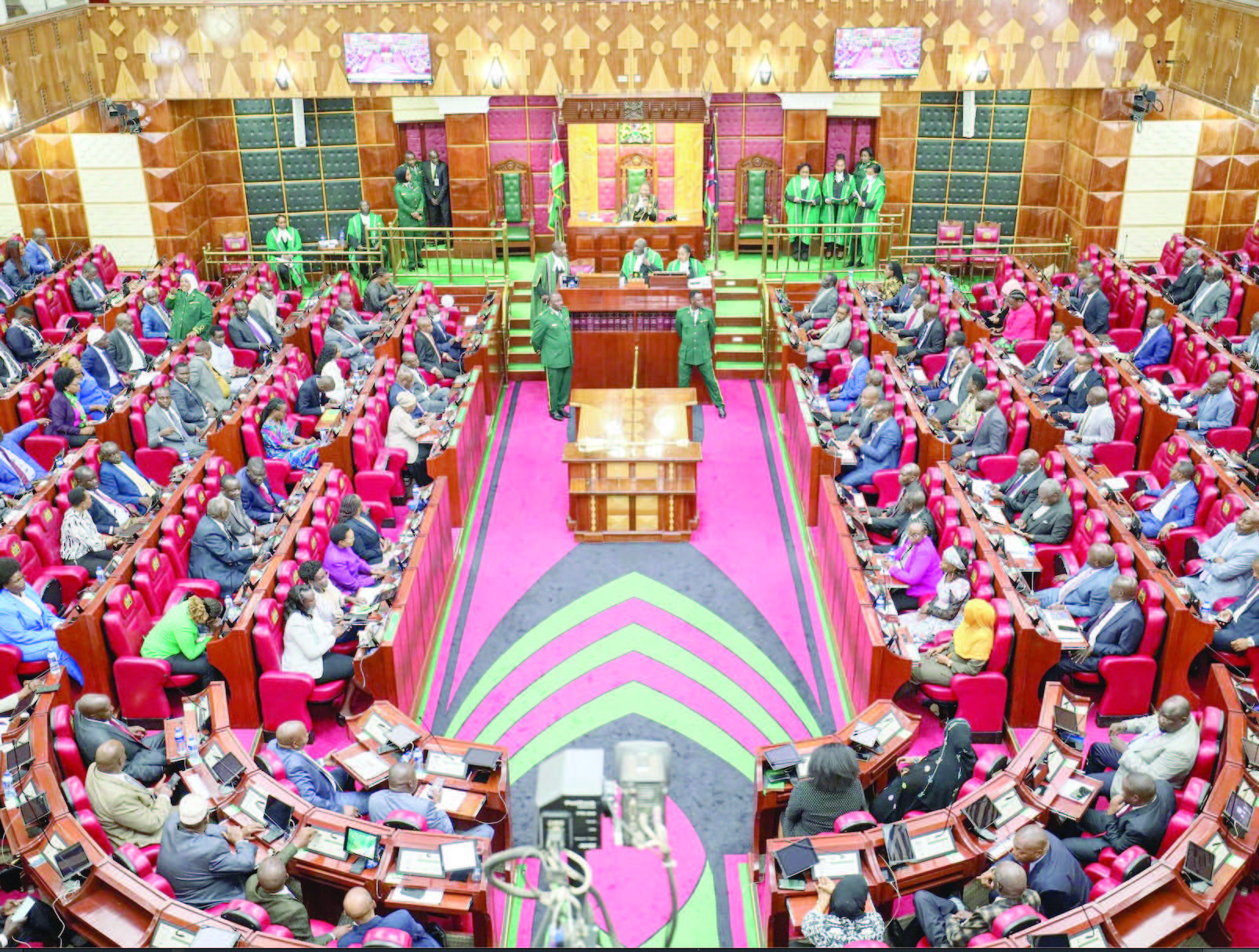


It is called the august House, a name meant to signify dignity and respect. Parliament is one of the most vital arms of government, the place where laws are made, policies debated, and national priorities shaped.
But these days, it looks less like a temple of democracy and more like an echo chamber for the State House. The institution that should check the executive has instead become its obedient choir.
On the morning of October 15, just as a dark cloud descended upon the nation following the news of former Prime Minister Raila Odinga’s death, President William Ruto was busy at State House.
As the sad news iltered in, he signed nine key bills into law, marking major reforms across the governance, economy, and digital sectors.
The new laws included the National Land Commission (Amendment) Bill, the Wildlife Conservation and Management (Amendment) Bill, the Land (Amendment) Bill, and the Privatization Bill.
Others were the Computer Misuse and Cybercrimes (Amendment) Bill, the Air Passenger Service Charge (Amendment) Bill, and the National Police Service Commission (Amendment) Bill.
The Privatization Act and the Virtual Asset Service Providers Bill, 2025, also became law, signaling what the government described as a renewed commitment to modernization, transparency, and enhanced service delivery in both public and private sectors.
But while the government celebrated the milestone, critics saw it as yet another sign of the State House’s tightening grip on Parliament.
Bad laws birthed by a Parliament controlled from the State House. That’s how opposition lawmakers now describe the state of Kenya’s legislature.
They say that no matter how loud they shout against controversial bills like the Computer Misuse and Cybercrimes Act or the Finance Bill 2024, their voices are drowned out by the heavy hand of executive inluence.
Saboti MP Caleb Amisi and Rarieda MP Otiende Amollo, for instance, say the mood of the House is no longer shaped by debate or conscience, but by command.
“People accuse MPs of passing oppressive laws without understanding how Parliament works,” says Amisi. “You can shout against a bad bill, but once the majority, often aligned with the President, votes for it, it passes. That’s how the system is built.” Amisi argues that Kenya’s problem goes beyond legislation.
“We’ve been cultured to normalize impunity and corruption,” he says. “It’s not just about bad laws. It’s how we follow and manipulate them. Until we ix our moral fabric and elect sober leaders, we’ll keep recycling the same failures.”
He adds that the country’s focus should be on economic revival rather than laws that silence dissent.
“Our youth are not protesting because of politics,” he says. “They are in the streets because of economic pain no jobs, no hope, no opportunities. We can’t ix that with cybercrime laws. Kenya needs an economic renaissance.”
Otiende Amollo, a senior opposition MP and constitutional lawyer, shares the same concern. He believes Parliament’s independence has been eroded by the politics of patronage.
“The broad-based government was meant to unite the country,” he says. “But one unintended efect has been the weakening of scrutiny and opposition. When we question certain bills, we’re branded as enemies of the government.”
He cites the example of the Kenya Pipeline Company’s proposed privatization.
“We opposed it strongly in the previous session, and it was withdrawn. But in the next session, it was sneaked back through a last-minute change in the order paper. By the time most MPs realized, it had already been passed. That’s not lawmaking — that’s legislation by ambush.”
According to Amollo, the “mood of Parliament,” often dictated by political alignment, has replaced independent thought.
“You can make a strong case against a bill, but once the Speaker puts the question and the majority carries it, that’s it.
Even those who opposed it are collectively blamed. Parliament needs to reclaim its independence because it is supposed to check the executive, not serve it.”
Observers and civil society groups agree that Kenya’s democracy is under strain. They warn that the growing perception of executive control over Parliament is fuelling public frustration, especially among young voters who feel their voices no longer matter.
Inside the House, ruling party loyalists defend the government’s legislative agenda, insisting it is focused on reform, iscal stability, and progress. They dismiss criticism as political theatrics meant to stir emotions.
Auditor-General Nancy Gathungu has also been on record accusing Parliament of abandoning its watchdog role. Her ofice has submitted 57 performance audit reports since 2020 only one has ever been debated.
“This failure has led to wastage, theft, and corruption,” she told MPs. “My oice can only be as impactful as Parliament allows it to be.”
Analysts say part of the problem lies in Kenya’s electoral culture. Elections are rarely about vision or legislative ability.
Instead, they revolve around money, tribe, and connections.
Voters expect MPs to “bring development” in the name of bursaries, roads, and handouts, not to make laws or enforce accountability. This forces many lawmakers to seek favours from the executive, reducing Parliament to a mere extension of the State House.
Concerned legislators argue that “this is Kenya’s true crisis of conscience.”
“It’s no longer about party lines,” says Amisi. “It’s about integrity and courage in standing up for Kenya when it matters most.”
CONTROVERSIAL LAWS
He signed nine key bills into law, marking major reforms across the governance, economy, and digital sectors
Bad laws birthed by a Parliament controlled from the State House. That’s how opposition lawmakers now describe the state of Kenya’s legislature.
2024
Year when the controversial Finance Bill raised a furore in the country leading to the infamous GenZ protests that saw thousands of young Kenyans storm parliament buildings