

Globally, the bio-economy is the new frontier in development, as countries strive to achieve the twin imperatives of meeting the growing needs of their populations for goods and services, as well as the urgent need for environmental conservation.
Bio-economy is defined as the knowledge-based production and utilisation of biological resources biological processes and principles to sustainably provide goods and services across all economic sectors.
It is a paradigm that has gained extensive recognition in the last 20 years.
Bio-based resources, such as agricultural, forestry, marine and aquatic resources form the backbone of Kenya’s economy. However, if the country is to develop its bioeconomy to become a driver of Vision 2030, it must raise the degree of bio-processing and value addition to agricultural, forestry or aquatic primary produce and bio-waste.
Encouragingly there is an increasing number of Micro and Small and Medium Enterprises (MSMEs), and communitydriven value addition initiatives in Kenya that are engaged in bioeconomy development. They are already creating employment and livelihood opportunities, hence promoting inclusive economic growth. Additionally, MSMES are also often pioneers and promoters of innovations in the bioeconomy. Kenya is now racing to develop its bioeconomy potential in collaboration with countries that have achieved great success in the sector.
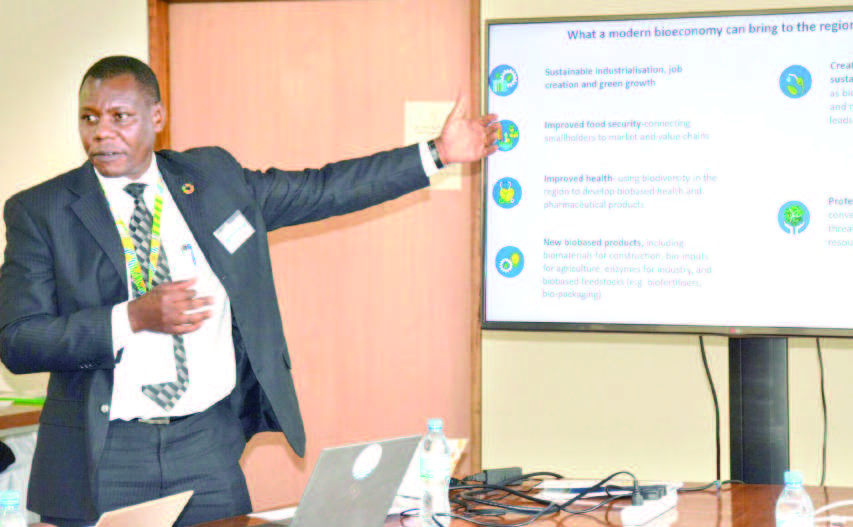
Last week, a workshop was organised in Nairobi by Stockholm Environment Institute (SEI) Africa Centre, the Kenya Private Sector Alliance (Kepsa), and Sweden Sverige to explore ways of strengthening investments in bio-based sectors in Kenya.
The participants included private sector entrepreneurs and businesses working in the bio-based sectors, policy makers in government, researchers and innovators, finance institutions, and representatives from international organisations.
The workshop discussed the challenges and opportunities for bioeconomy for the private sector in Kenya, reviewed the key factors that influence the participation of MSMEs in bioeconomy, including policy regulation and standards, finance and capital, and markets infrastructure and technologies. They also shared lessons from Sweden on the development of bioeconomy pathways and explored opportunities of linkages with the Kenyan private sector.
Speaking at the workshop, the SEI Africa Centre Director, Dr Philip Osano, observed that Kenya has a strong commitment to biodiversity. He noted that Kenya has developed several policies, laws and programmes to promote a low carbon development pathway.
These include The Green Economy Strategy and Implementation Plan (2016- 2030), the Draft National Green Fiscal Incentives Policy Framework, the Draft Kenya National Biodiversity Strategy and Action Plan (2019-2030), the National Forest Policy, and the National Sustainable Waste Management Policy.
To address Climate Change, the country has developed the National Climate Change Action Plan (2023-2027), Nationally Determined Contributions (NDCs), Climate Change Act, and Climate Change policy.
Huge prospects
“The Draft Science, Technology and Innovation (STI) policy 2020-2030 provides a framework for technological growth to support bioeconomy development in Kenya, thus enabling the integration of MSMEs in the bio-based sectors into national, regional and global trade networks,’ he noted.
The Business Development Manager of BioInnovate Africa, Mrs Shira Mukiibi, noted that as populations increase and as more people live in cities and urban centres, the demand for agricultural produce and value-added products like food, feed, energy, medicine and other essentials like cosmetics, detergents and industrial chemicals, from renewable bio-resources, will inevitably rise.
The prospects for growth in the bioeconomy were huge, enabled by the digital economy, she said, noting that globally, the bioeconomy was growing at 3.3 per cent per annum, and was estimated to be worth US$ 7.7 trillion by 2030.
Mukiibi identified several drivers of this growth including climate change and eforts towards low carbon emissions, disease outbreaks like the Covid-19 pandemic and the need for more resilient supply chains.
Buttressing this potential is an extensive network of biotech institutions that have made it among the leading African countries in developing its bioeconomy. These include bodies and authorities such as the National Commission for Science, Technology and Innovation (NACOSTI), the Kenya National Innovation Agency (Kenia), and the National Research Fund (NRF).
The workshop was part of a project named ‘Advancing Bioeconomy Development in Kenya (ABDK)’, which is being implemented by SEI Africa Centre, an international non-profit research and policy organisation. The project’s three pillars are, supporting the development of bioeconomy pathways for diferent biobased sectors through collaboration between Kenyan and Swedish bioeconomy actors; generating evidence of business opportunities in bio-based sectors targeting MSMEs; and promoting national and international policy engagement on bioeconomy.
The ABDK project will contribute towards the achievement of three objectives of the Kenya Vision 2030 fourth Medium Term Plan (MTP IV) 2023-2027, namely, eradicating hunger (zero hunger), creating on average 1.2 million new jobs annually and achieving inclusive growth (leaving no one behind).
Additionally, the project also contributes directly towards the realisation of some of the sustainability policy priorities of the Kenya government on climate change, biodiversity, and pollution and waste management.
Further, this project seeks to promote partnerships between Kenya and Sweden private sectors. In Sweden, the bioeconomy is estimated to account for more than eight per cent of Sweden’s total value added, 12 per cent of the total turnover, and more than 20 per cent of the total export value.