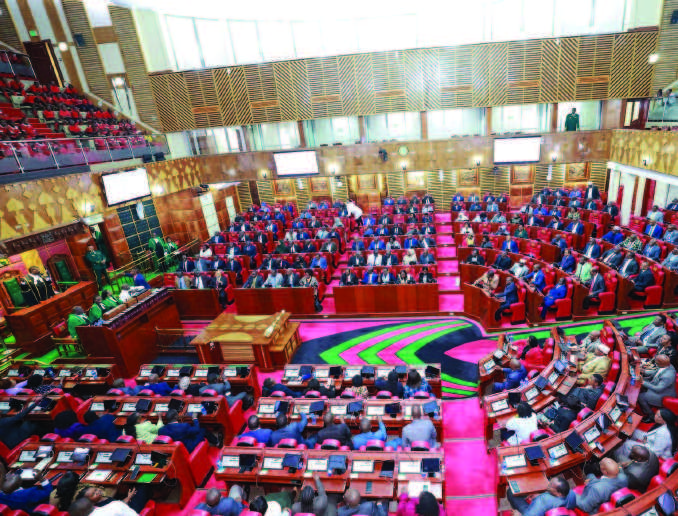


The recent debate on the Finance Bill in Parliament exposed a worrying trend within Kenya’s legislative process when some MPs appeared unconversant when debating one of the country’s most consequential policy documents. The Finance Bill directly affects taxation, government revenue collection, business operations, and the cost of living and doing business for millions of Kenyans.
As representatives of the citizens, MPs are elected to scrutinise legislation, present the interests of their constituents and hold the Executive accountable. Ideally, debates on critical documents such as the Finance Bill should be guided by facts, legal interpretation, economic analysis and the likely impact of proposed measures on citizens.
Yet portions of the debate raised questions about whether some legislators had taken suicient time to read, understand, and interrogate the proposals before taking positions on the floor of the House.
The recent proceedings appear dominated by political alignments rather than substantive policy arguments. Several legislators seemed to support or oppose provisions largely based on their political ailiations.
Members aligned with the government defended the Bill while many opposition lawmakers rejected it, sometimes without presenting detailed analysis of the specific clauses under discussion. This political polarization overshadowed what should have been a rigorous examination of the proposed tax measures.
Heated exchanges
One of the most notable moments occurred when Mavoko MP Patrick King’ola criticised a clause, arguing that it would require all businesses, including smallscale traders such as boda boda operators and mama mboga, to issue invoices.
“If you look at Clause 29, it was proposing that every person who does any business should provide an invoice, and I was wondering at what point mama mboga, boda bodas, and other small-scale entrepreneurs would do that,” King’ola said.
His remarks were immediately challenged by Majority Leader Kimani Ichung’wah, who demanded that he point out the exact section of the Bill containing the requirement he was referring to.
“Show us in this Bill the invoices you are alleging are there. It is OK to say things elsewhere, but not here honestly,” Ichung’wah responded.
As King’ola attempted to locate the provision, the presiding chairperson even offered him spectacles to assist him in reading the clause.
Another controversial moment was during debate on the Certificate of Origin (CoO), a key international trade document used to determine the country where goods are manufactured or processed.
Kirinyaga Woman Representative Njeri Maina argued that small-scale importers do not require a CoO.
“I can confirm because I have been a small-time importer. There is no point where someone importing two or three cartons needs a Certificate of Origin,” she said.
When asked by the chairperson to explain which alternative documents are used instead, Maina cited invoices and customs payments. However, the chairperson of the Finance Bill Committee responded by reading the existing law, specifically Section 44A of the Tax Procedures Act.
Kiharu MP Ndindi Nyoro also found himself at the centre of heated exchanges after questioning debt management structures and government borrowing plans. In response, Ichung’wah accused him of selectively presenting information for political mileage.
Kathiani MP Robert Mbui also faced scrutiny after claiming that the Bill proposed a tax on second hand clothes, commonly known as mitumba. When challenged to identify the specific clause introducing the tax, he was unable to immediately substantiate the claim.
Mbui however said that the Bill was lengthy and requested more time to locate the provision.
“This is a huge Bill. I will have to go through it clause by clause so that I can find it,” he said before eventually withdrawing the statement.
These incidents collectively painted a picture of legislators struggling to substantiate claims made during one of the most important debates of the parliamentary calendar. There is also a need for lawmakers to familiarise themselves with existing legal provisions before challenging them on the floor of Parliament.
What makes the situation more concerning is that MPs have access to extensive institutional support. Parliamentary committees are backed by legal experts, economists, researchers, and technical staff whose responsibility is to analyse legislation and provide lawmakers with professional guidance. Members also have access to committee reports and research briefs designed to simplify complex legislative documents.
Yet, some lawmakers still appeared illprepared, raising concerns about the quality of scrutiny applied to legislation that directly impacts millions of Kenyans. The debate also revived longstanding concerns about whether political loyalty sometimes takes precedence over objective analysis in Parliament.
Former Gatundu South MP Moses Kuria once alleged that attempts to influence voting patterns within Parliament were not uncommon, claiming in 2021 that inducements had been used to sway members on various legislative matters.
“It is not unusual for members to get this kind of an inducement,” Kuria said.
Whether or not such claims hold true today, the Finance Bill debate was cringeworthy viewing for mwananchi. Parliament’s credibility ultimately depends not on the volume of debate, but on the quality of the arguments presented and the depth of understanding behind them.
POLITICS OVER POLICY
Lawmakers appeared illprepared, raising concerns about the quality of scrutiny applied to legislation that directly impacts millions of Kenyans
Proceedings dominated by political alignments rather than substantive policy arguments, with MPs seeming to support or oppose provisions largely based on their affiliations