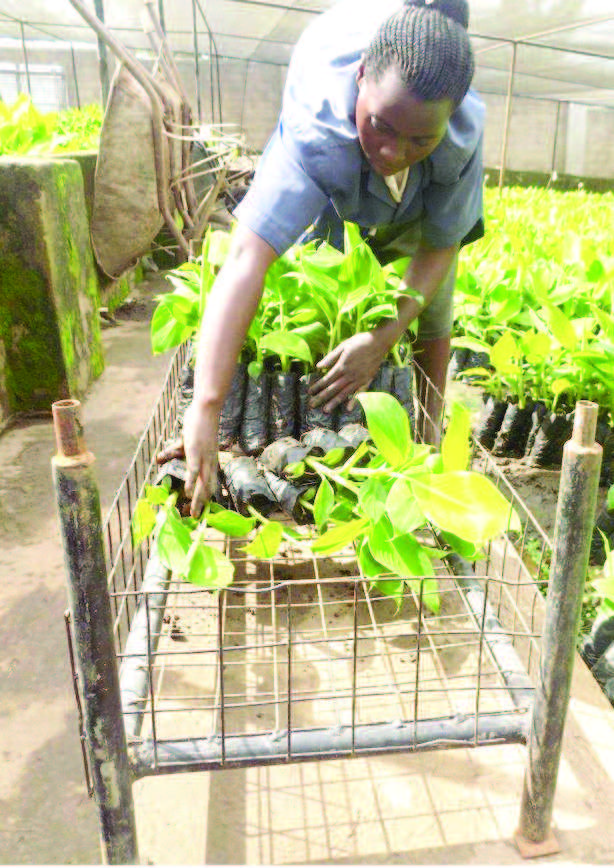


In the wake of major concerns about environmental degradation even as countries seek to grow their economies, the new economic dispensation is the exploitation of biological resources and processes to achieve the desired green growth.
This development paradigm is known as the bioeconomy, which the Bioeconomy Council defines as to the knowledgebased production and use of biological resources to provide products, processes and services in all economic sectors within the frame of a sustainable economic system.
The bioeconomy has become the new global growth area, as countries look for strategies to address value addition to bioresources (those that come from living organisms). These includes biowaste, climate change mitigation and adaptation, and biodiversity loss.
Bioeconomy involves use of scientific knowledge to add economic and social value to biological resources in a sustainable way.
All over the world, the bioeconomy is gaining traction as a sustainable pathway for the future, with less carbon emissions, and preservation of biodiversity.
Kenya is developing a strong bioeconomy sector, driven by an extensive network of biotech institutions that have made it among the leading African countries.
The government has established an ecosystem of research, science, technology and innovation organisations that provide the foundation on which the country can develop its bioeconomy. These include bodies and authorities such as the National Commission for Science, Technology and Innovation (NACOSTI), the Kenya National Innovation Agency (KENIA), and the National Research Fund (NRF).
The country’s ambition in pushing for the development of its bioeconomy was manifested when the country hosted the Global Bioeconomy Summit (GBS 2024) in Nairobi on October 23-24, 2024. The delegates met to take stock of the state of the global bioeconomy, and what needed to be done to accelerate its growth. This was the first time that the Global Bioeconomy Summit was being held in Africa.
The organisations that were behind the successful hosting of the GBS 2024 were the East African Science and Technology Commission (EASTECO), the East African Community (EAC), the International Centre for Insect Physiology and Ecology (ICIPE), BioInnovate, and the Stockholm Environment Institute (SEI).
The Summit was attended by over 600 participants in person, representing 50 countries.
For Kenya and Africa, bioeconomy is a natural pathway, given that agriculture is the dominant economic sector. Agriculture, therefore, presents one of the sectors with the highest potential for development of the bioeconomy. Indeed, agriculture contributes between 23-35 per cent of the Gross Domestic Product (GDP) of most sub-Saharan African countries. A lot of biomass is generated by agriculture, which is the building block of the bioeconomy.
Countries like Brazil and Argentina have become global leaders in the bioeconomy by leveraging their agricultural sectors.
Brazil’s biofuel industry, which is based on sugarcane ethanol, is one of the world’s most advanced, while Argentina heavily relies on its agricultural sector for its well-developed bioeconomy. This shows that countries like Kenya have massive untapped potential to develop their bioeconomy.
The East African region has adopted a collective approach to the development of the bioeconomy. As a demonstration of the region’s commitment to build a vibrant bioeconomy in East Africa, the East African Community (EAC), under the leadership of Kenya, developed a bioeconomy dedicated strategy in 2022.
Regional report
The strategy prioritises food security, health and wellbeing, bioenergy, and sustainable industries. It is aligned with the East African Vision 2050, and the United Nations Sustainable Development Goals 2023.
The countries of the EAC are closely monitoring progress in the development of the bioeconomy.
The report of the State of the bioeconomy in Eastern Africa 2024 was launched during the GBS Summit 2024. The 2024 report builds upon the foundational work presented in the inaugural 2022 report.
While the initial report provided an overview of the state of the bioeconomy across Eastern Africa, the 2024 report focusses specifically on food security and sustainable agriculture. It also gives an update on recent bioeconomy developments in the region.
The very development of a bioeconomy blueprint for the EAC places the region on a sound footing to benefit from the technological advances that are being made globally in this sphere. It demonstrates that the region is alive to the imperative now driving development, of ensuring sustainability of the environment even as it seeks to produce enough goods and services to cater for a rapidly growing population, and rising urbanization.
The report notes that although Kenya has yet to develop an overall bioeconomy strategy, policy or regulations, the regulation of the bioeconomy in Kenya is organised across various policy frameworks for development.
Such frameworks include the land use policy, tourism policy, climate change policy, water policy, food and nutrition policy, among others, and are well positioned to provide support for the implementation of the bioeconomy agenda.
The report notes that Kenya has developed various sector-specific policies that buttress the growth of the bioeconomy.
These include the National Biotechnology and Development Policy, the National Biosafety Act, and the Science, Technology and Innovation Act.
There is, however, a lot of work to be done. Experts say that to ensure that nobody is left behind, the global community must consider supporting countries and regions to have clear policies and strategies for the bioeconomy according to their unique natural advantages, and societal needs.
Further, they should support innovation and entrepreneurial activities around value addition and agro/bioprocessing to create jobs for youth and incomes for families, especially through universityindustry partnerships, given the scientific input necessary for the bioeconomy to thrive.
Bioeconomy co-operation should be encouraged, especially around issues of standards, financing and education, research and training.
They note further that since the bioeconomy is becoming the growth pathway for a green future in global economies, collective efforts bringing together government, private sector, civil society and academia should be made to develop the bioeconomy according to local aspirations.